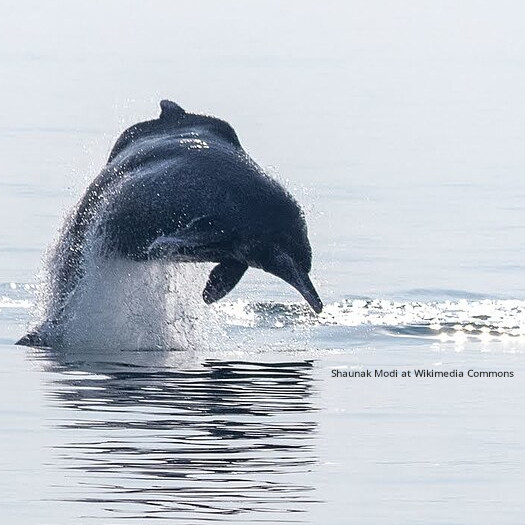
Those who sail or boat on coastal waters are used to seeing dolphins playing by their vessels. It is hard to believe in some areas the merry dolphin is endangered, sometimes critically so.
Humpback dolphins differ not only in temperament from other dolphins, they have a distinctive larger dorsal fin on their backs, with a smaller triangle sitting on the top.
They are found in warm, shallow coastal waters in Africa, Asia and Australia, and might live to between 20 to 40 years. Since they actively avoid man, unlike many other dolphin species, not as much is known about them.
Since humpback dolphins live close to humans, they are subject to pollution, habitat loss, entanglement in fishing nets, and in some areas, hunting. Although they are smart enough to stay away from many engine-powered boats, sometimes they cannot resist unwanted fish thrown from trawlers, and end up as by-catch themselves. Noises made by maritime shipping, construction and machinery also distress the mammals.
Climate change disproportionately affects these coastal animals. They do not live in the colder parts of the ocean, and warm coastal waters that are expected to get even hotter than average.
Plastic pollution can also be a factor. “Large blockages in the water can refract sound-waves, misleading the dolphin to falsely detect prey, kin, or a predator in the area. This can become confusing and frustrating which can lead to extreme stress and potential health issues,” Animalia.bio stated.
Unfortunately, the Atlantic humpback dolphin and Indo-Pacific humpback dolphin are endangered. The Atlantic humpback dolphin critically so.
Atlantic Humpback Dolphin
Africa, from Morocco to Angola are home to the Atlantic species of humpback dolphin. But may be extinct in the Cameroon.
It is thought that less than 3,000 individuals are left of this species, according to NOAA Fisheries (National Oceanic and Atmospheric Administration).
They differ because they have fewer teeth at 33 to 37 than other humpback dolphin species, and thus have a wider skull. Atlantic humpback dolphins are mostly grey and white.
Taiwanese Humpback Dolphin
As opposed to many humpback dolphin species, the adult Taiwanese subspecies of the Indo-Pacific humpback dolphins are pink. This is because of an adaptation to deal with the warmer waters of the Philippine Sea, and the Luzon and Taiwan Straits.
The Taiwan Panorama website reported in 2010 that it was thought that there only maybe 100 of the subspecies left. “Ironically, it is only in the last year or two that most people in Taiwan even became aware that there were” pink dolphins there, they reported.
Thankfully, the citizens of Taiwan were able to stop a large, dolphin-threatening project in 2011. A proposed Kuokuang Changhua County petrochemical plant was shelved The Global Atlas of Environmental Justice stated. And it was because “civil groups warned that there could be significant environmental impacts, including those on air pollution, human health risks, changes to coastal geography … and the area’s water supply,” not just pink dolphins.
To save any coastal dolphins, it has been suggested that laws can do something. Marine areas can be protected, and policing bycatch discouraged, if directives are enforced. Also, laws about using fishing nets farther from the shore are recommended.
As always, the education of local peoples about the threats to animals is a very good start.
June 8th is World Ocean Day!
Read more about Humpback Dolphins

Sources
Indo-Pacific Humpback Dolphin. (2026). Animalia.bio. https://animalia.bio/indo-pacific-humpback-dolphin
Atlantic Humpback Dolphin. (2025, July 30). NOAA Fisheries. https://www.fisheries.noaa.gov/species/atlantic-humpback-dolphin
Indo-Pacific humpback dolphin. (2026, June 1). Bottom of Form
Wikipedia. https://en.wikipedia.org/wiki/Indo-Pacific_humpback_dolphin
Humpback Dolphins Sending an SOS to the World. (2010, August 1). Taiwan Panorama. https://www.taiwan-panorama.com/en/Articles/Details?Guid=89f03343-decf-4a39-ae66-af0dc55c773b&CatId=7&postname=Humpback%20Dolphins%20Sending%20an%20SOS%20to%20the%20World&srsltid=AfmBOooCSEB0u8yFKXh606nBqQUlqxSrvaPWaEO5hvsj2tu-EAg4-mF2
Kuokuang Petrochemical Technology Company, Taiwan. (2023, May 13). Global Atlas of Environmental Justice. https://ejatlas.org/conflict/kuokuang-petrochemical-technology-company-taiwan
You must be logged in to post a comment.