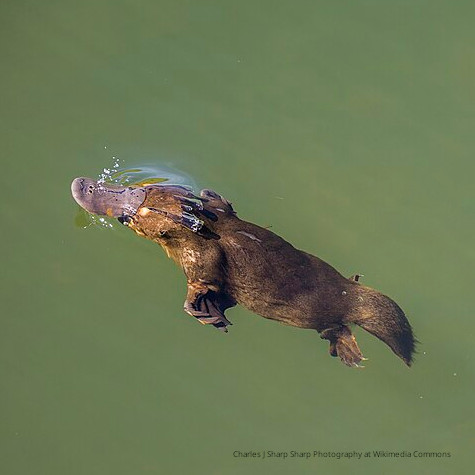
Platypuses are among only two mammals that do not have live young. Along with the echidna, (spiny anteaters), they are the only mammals that lay eggs. After laying approximately two eggs, a female platypus curls up around them to keep the eggs warm. A platypus’ body temperature is about 5°C (9°F) less than most mammals, (about 37 °C, or 99 °F). Platypus eggs hatch after 10 days, and mothers raise until they are mature at about four months. Platypuses only reproduce at about two years of age, and can live to be about ten.
Sanctuaries for Platypuses
In Australia, bushfires have affected many animals including the very unusual-looking Platypus. However, the Australian state of New South Wales and the Taronga Conservation Society have established the Platypus Rescue at Taronga Zoo. Platypus Park at Tarzali Lakes, and Healesville Sanctuary are important conservation areas. Platypus House in Tasmania and Bombala Platypus Reserve offering viewing opportunities.
Platypuses, are shy and easily spooked, and can only be seen late in the evening, at night, or in the early morning — making them difficult for researchers to study. They are also hard to keep in captivity, and few have bred in zoos. Most notably, babies have been born in the Melbourne Healesville Sanctuary, and at the Taronga Zoo.
Pollution, dams, land development, climate change, trapping, netting, fire and drought are all known to have affected the platypus. Also due to man, their numbers have dropped at least thirty percent in the last few centuries.
Diet, Habitat and Behaviour
Platypuses have beaver-like tails, webbed feet, prey-sensing snouts, and folds on the top of their bills. Strangely the ridge hides their eyes and ears in murky waters, so platypuses find meals using electroreceptors in their beaks. These bills can sense movement in their prey due to electrical activity. Platypuses live in rivers, and streams, and are known to spend half their time foraging for grubs, worms, insects and shellfish.
Male platypus have half inch spurs on their hind legs that are used to fight during mating. Although not poisonous to humans, their venom still packs quite a wallop. The pain is very rough and can last for days. The venom is even resistant to morphine and other pain killers. One day, it is thought that science will be able to isolate the chemicals found in platypus venom and use them to fight diabetes.
Platypuses are found along the eastern coast in the Victoria, Queensland, New South Wales South Australia areas, in Australia, and in Tasmania. Unfortunately, however, they are thought to be getting scarcer in Southern Australia.
How to protect Platypus Habitat
Since platypus live in burrows usually found just above the water line in streams and rivers; erosion is a serious concern. Weeds along the water, considered to be pests–are often removed–resulting in destruction of platypus habitat. Experts, who think that streamside willow trees produce too many leaves, and not many of the larger branches that platypus like; recommend willows be removed, and other vegetation planted in its place.
Dams, should be supplied with graduated fish ladders, that will allow fish and platypuses a way to return to their former habitats. But — if fish ladders are not feasible — large amounts of vegetation, (at least approximately 30 metres or yards wide along the shore), should be planted for skittish platypuses to hide in, so that they can get around dams.
ICUN Status
Platypuses are protected by the EPBC Act in Australia. And the International Union for Conservation of Nature and Natural Resources (IUCN), has classified the platypus are ‘near threatened’. In the State of Victoria the platypus is listed as threatened, while in South Australia it is considered threatened. The country is discussing listing the platypus as threatened.
Many, however, don’t see the platypus being on the road to extinction. Yet there still are scientists, like Dr. Gilad Bino, at the UNSW Centre for Ecosystem Science, who argue that platypuses will loose 40 per cent of their current habitats in the future; due to runaway, manmade development.
Sources
The Platypus Is Weirder Than You Ever Imagined. (2023, March 9). The Nature Conservancy. https://blog.nature.org/2019/10/07/the-platypus-is-weirder-than-you-ever-imagined/
“Climate disasters prompt Australia’s first platypus refuge”. (2021). CTV News. https://www.ctvnews.ca/climate-and-environment/climate-disasters-prompt-australia-s-first-platypus-refuge-1.5333213
Platypus. (2016, 29 April 29). Department of Environment and Science, State of Queensland, Australia. https://environment.des.qld.gov.au/wildlife/animals/a-z/platypus
Let’s protect the platypus. (2021). Australian Conservation Foundation. https://www.acf.org.au/platypus
The silent decline of the platypus, Australia’s beloved oddity. (2019, August 29). National Geographic Partners, LLC. https://www.nationalgeographic.com/animals/article/common-platypus-disappearing-australia
Platypus on brink of extinction. (2020, 21 January). ScienceDaily, University of New South Wales. <www.sciencedaily.com/releases/2020/01/200121112922.htm>.
Platypus. (2021). International Union for Conservation of Nature and Natural Resources. IUCN: The IUCN Red List of Threatened Species. Version 2020-3. https://www.iucnredlist.org/species/40488/21964009
Platypus Management Guidelines. (2025). Australian Platypus Conservancy https://platypus.asn.au/management-guidelines/
Australia’s first ever platypus sanctuary. (2021). BBC News. https://www.bbc.co.uk/newsround/56264827
Platypus. (2021, February 21). Wikipedia. https://en.wikipedia.org/wiki/Platypus
Glum future for the platypus: why the elusive mammal is disappearing under our noses. (2021, February 11). Guardian News & Media Limited. https://www.theguardian.com/environment/2021/jan/09/glum-future-for-the-platypus-why-the-elusive-mammal-is-disappearing-under-our-noses
Platypus Australian status: Platypus conservation status. (2025). Australian Platypus Conservancy. https://platypus.asn.au/conservation-status/