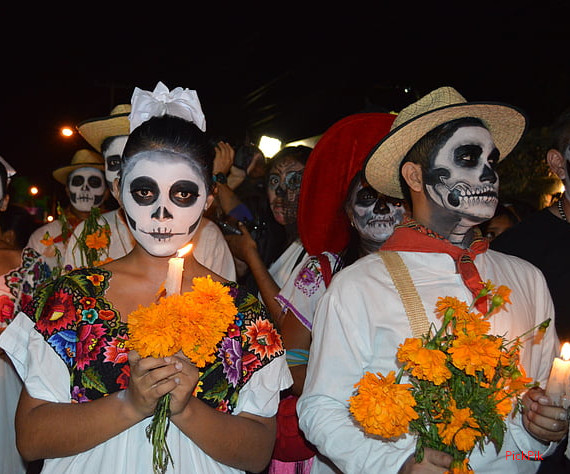
The Day of the Dead in Latin America, celebrates the cycle of life! With butterflies! Monarch butterflies! The Journey North website has also reported the first monarchs are now in Mexico, after arriving about October 22nd .
In Mexico Día de los Muertos (Day of the Dead in Spanish) is often celebrated on November 1st and 2nd, and honors family members and friends, who have passed away and are missed. As it is called All Souls’ Day in the Catholic religion, it can be confusing.
Although some think the festival started in Mexico, other countries like Peru (November 1st), Costa Rica (November 2nd), Haiti (November 1st and 2nd), the Phillipines (November 1st and 2nd), Spain (November 2nd), Guatamala (November 1st), Ecuador (November 2nd), Bolivia (November 1st and 2nd), El Salvador (November 1st), and Brazil (November 2nd), have their own customs.
In Mexico, monarch butterflies are believed to be the spirits of their ancestors returning. Sugar skulls (Calavera), and orange marigold flowers are left in graveyards, or on home altars or shrines for their dearly departed. The scent of the flowers, and the light of candles, guide the dead back from the underworld to their friends and relatives.
Traditionally, this is also a feast that includes the deceased’s favorite foods. Pan de Muerto (a sweetened pumpkin bread or roll), as well as sugar skulls, are given out as gifts during the meal. Paper cut-outs are made to represent the transitory nature of life. Those who have passed on are also remembered in funny stories, poems, and witty recreations of grave stones. Celebrants also poke fun at celebrating living famous people and friends.
Some think that the holiday does not have ancient Aztec roots, rather it was instituted to give Mexico a national identity by President Lazaro Cardenas in the mid 20th century. Historian Elsa Malvido, an INAH – National Institute of Anthropology and History, or Instituto Nacional de Antropología e Historia member, says that the custom is too widespread to have been just Cardenas’ idea. In the 19th century, it is known that there were processions to graveyards that honored ancestors.
Around 1850, famed Mexican lithographic artist José Guadalupe Posada also created a character called La Calvera Catrina. She is depicted as a skeleton or just a skull, usually wearing a fashionable hat or sombrero.
Although the Day of the Dead is not Halloween, some from the Latin diaspora have also included the tradition of going from door to door to get sweets, and then threaten tricks if they are not given them–but not all.
Above all, the Day of the Dead is meant to be a party, that can include dancing. It might also be termed a ‘wake’ where friends and family get together to reminisce.

Sources
15 Things to Know About the Day of the Dead (Día de Muertos): The origins and symbols of the Mexican and Central American holiday that takes place in early November are part of a long tradition. Good Housekeeping: Hearst Magazine Media, Inc. (2024, October 28). https://www.goodhousekeeping.com/holidays/g33792819/day-of-the-dead-facts/?utm_source=google&utm_medium=cpc&utm_campaign=mgu_ga_ghk_md_pmx_hybd_mix_ca
Day of the Dead. Wikipedia. (2025, November 1). https://en.wikipedia.org/wiki/Day_of_the_Dead
Monarch Butterflies. The Journey North. (2025, October 22). https://journeynorth.org/monarchs/news/fall-2025/102225-western-monarch-count-begins-monarch-roosts-mexico
Monarch Migration. Monarch Watch. (2025). https://www.monarchwatch.org/migration/
José Guadalupe Posada. Wikipedia. (2025, July 18). https://en.wikipedia.org/wiki/Jos%C3%A9_Guadalupe_Posada
What is a Wake? Farewelling. (2021). https://www.myfarewelling.com/article/what-is-a-wake
You must be logged in to post a comment.