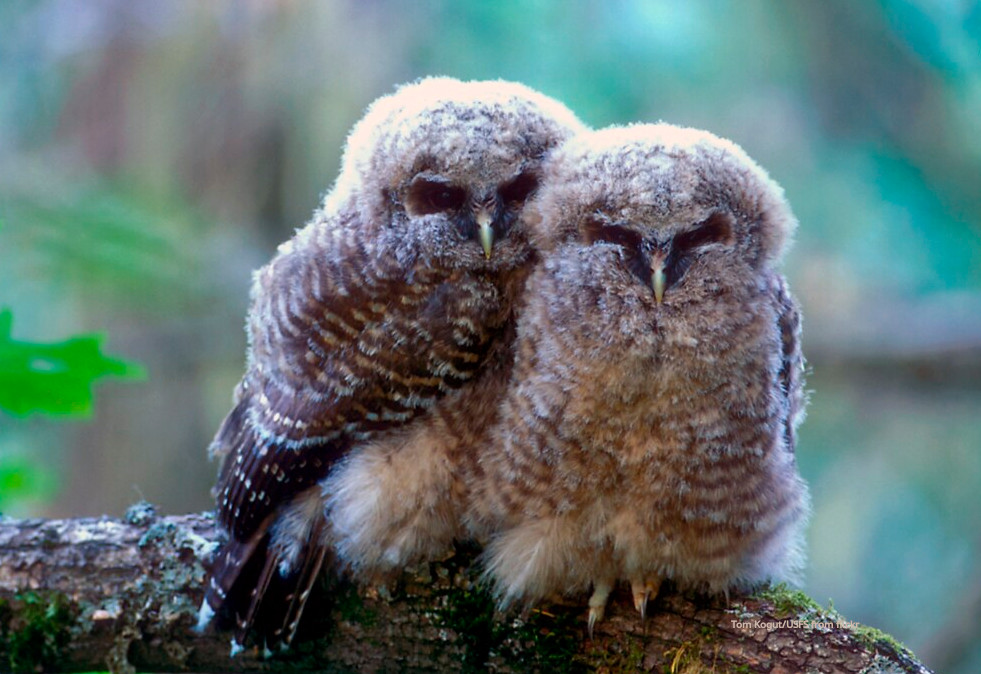
With only three northern spotted owls living in the wilds in Canada in 2022, the species was all but extinct. With its departure there could be that much less beauty in our country.
The habitat of the northern spotted owl is diminishing. They live in 140 to 250-year-old trees in British Columbia, where only about three percent of ancient trees remain, according to a report by Dr. Karen Price et al called “BC’s Old Growth Forest: A Last Stand for Biodiversity.” It is a very controversial statistic, and some sources claim 23 percent of old-growth forests remain. However, the logging of old-growth forests is still exist.
The medium-sized owls are also being outcompeted by larger barred owls, who can be 25 inches (63 cm)—while larger adult northern spotted owls are closer to 19 inches (48 cm). Barred owls also have smaller territories, so more of them can populate an area. Northern spotted owls are found in Southwestern BC, Washington, Oregon and Northwestern California.
The diets of northern spotted owls consist of small mammals like voles, mice, rats, squirrels, and reptiles, and insects.
Northern spotted owls lay eggs in April or May–which are guarded by females–while the males feed them. About a month later, fledglings find their own territories, usually less than 24 miles (40 km) from their parents. This is another problem for the young northern spotted owl, as they can only fly so far without finding territory. The result can be starvation.
Conservation
To stave off extinction the Northern Spotted Owl Breeding Program (NSOBP) was started in 2007, and became part of the BC Conservation Foundation in 2014. To give the rare owl a chance of survival, chicks are hand-reared. Dummy eggs are given to the parents, while their eggs are incubated at precise temperatures. After about two weeks from hatching, the chicks are given back to their parents to raise in a controlled environment.
Fledglings are then put into an enclosed aviary to get used to living in the wild. Once they are about two years old, the healthy owls are released. The doors to their aviary are opened, and they fly out when they are ready.
Learn more about The Northern Spotted Owl.
Sources
Northern Spotted Owl Breeding Program. (2025). NSO Breeding Program. https://www.nsobreedingprogram.com/
Provincial data shows increase in old-growth logging, contrary to B.C.’s earlier figures: conservationists. Figures from both Sierra Club and province show area of old-growth trees cut in 2021 was higher than in 2020. (2023, October 5). CBC News. https://www.cbc.ca/news/canada/british-columbia/old-growth-logging-british-columbia-how-much-is-harvested-each-year-1.6987777
Northern spotted owl. (2025, January 22). Wikipedia. https://en.wikipedia.org/wiki/Northern_spotted_owl
‘All I see are ghosts’: fear and fury as the last spotted owl in Canada fights for survival. (2023, May 26). The Guardian. https://www.theguardian.com/environment/2023/may/26/northern-spotted-owl-canada-british-columbia-ghosts-aoe
BC’s old growth forest: A Last stand for biodiversity. (2020, April). Veridian Ecological Consulting. https://veridianecological.files.wordpress.com/2020/05/bcs-old-growth-forest-report-web.pdf