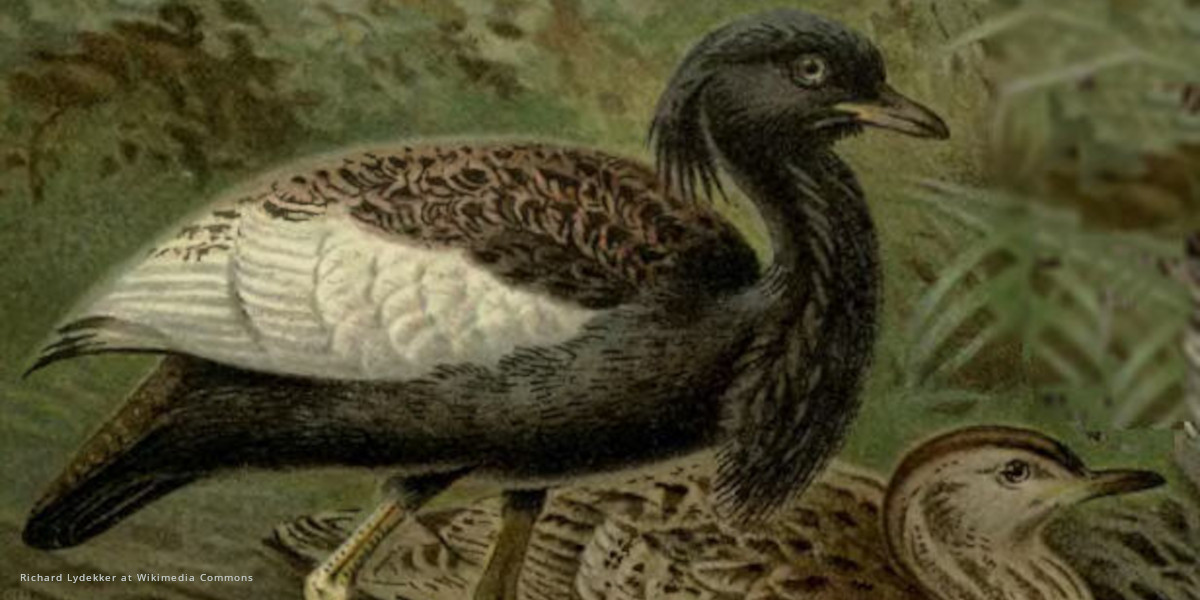
Conservationists in Cambodia have been making strides towards saving a critically endangered bird species called the Belgian florican—even if the birds may seem not to be helping.
Belgian florican are known to abandon protected conservation areas before monsoon rains. They leave the safe areas because they dislike it when the wet grass grows gets too high. Then they become their own worst enemies.
The birds are about the size of ducks. When they migrate back to unprotected areas, some hunters–who consider them good eating–know where and when to expect them. The birds faithfully return to the same patch of ground each year.
Belgian floricans do not make it easy for conservationists!
There were only 600 left in Cambodian wilds of the Tonle Sap Floodplains in 2019. At the Angkor Centre for Conservation of Biodiversity (ACCB) researchers have raised more than ten baby birds, and housed half a dozen others for their own safety. Cambodian conservationists are using flexible soft-sided, and high-ceilinged enclosures to protect birds. It allows conservationists to keep them safe, as well as reduce interaction with man that leads to domestication.
Bengal florican are native to grassland areas in northern India, Cambodia, and southern Nepal. Increasing agricultural lands, invasive species, logging, and feral cattle mean fewer birds. Many conservationists are trying to educate local populations, and show that the Bengal florican can boost tourism dollars.
In Nepal, there are even fewer birds. Although there is a new action plan for the conservation of the critically endangered bird, funding has been scarce. Conservationists like Mohan Bikram Shrestha, are reporting extinction-level populations. “We have been saying for a long time that the population of Bengal floricans in Nepal is less than 100… We hope that after the implementation of the plan, we get to say it’s at least above 100. That could be a possible metric for restoration of population,” Mongabay has reported.
It is thought that between a total of 1,000 and 1,500 birds are left in the wild; but in a 2023 survey, only 24 birds were found in Nepal. While in India, the population is thought to include less than 100 males, with about 60 in the D’Ering Wildlife Sanctuary.
Bengal floricans tend to hide in grasslands. It is only during mating, that they are easier to find. Then, famously, the male Bengal florican leaps six to nine feet (2 to 3 m) in the air to attract females.
Sources
Asia’s Extraordinary Jumping Bird Now Thriving in Captivity–a Hopeful Halt to Population Slide. (2025, January 10). World at Large News. https://www.worldatlarge.news/2025/01/10/asias-extraordinary-jumping-bird-now-thriving-in-captivity-a-hopeful-halt-to-population-slide/
Nepal launches new plan to boost critically endangered Bengal florican. (2024, June 30). Mongabay. https://news.mongabay.com/2024/06/nepal-launches-new-plan-to-boost-critically-endangered-bengal-florican/
Belgian florican. (2023, December 31). Wikipedia. https://en.wikipedia.org/wiki/Bengal_florican
In pursuit of the rare bird that vanishes for half the year. (2018, November 27). Mongabay. https://news.mongabay.com/2018/11/in-pursuit-of-the-rare-bird-that-vanishes-for-half-the-year/
Bengal Florican Houbaropsis bengalensis. (2025, January 20). Birdlife International. https://datazone.birdlife.org/species/factsheet/bengal-florican-houbaropsis-bengalensis/text
BirdLife International (2025) Species factsheet: Bengal Florican Houbaropsis bengalensis. Downloaded from https://datazone.birdlife.org/species/factsheet/bengal-florican-houbaropsis-bengalensis on 19/01/2025.
Rural Traveller. “Patience Rewarded.” Facebook. https://www.facebook.com/reel/1249872759401826