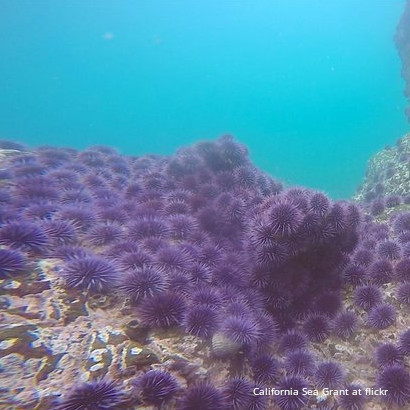
Although many may not see kelp forests as being valuable, it is clear that they are diminishing.
By attacking the root of kelp stalks sea urchins are creating urchin barrens. Could sea otters and sunflower sea stars be an answer to this global problem?
Kelp combats carbon monoxide levels
Kelp can help alleviate ocean acidification by removing carbon dioxide; as well as providing a safe shelter for many marine animals and their young. The World Resources Institute has reported that “in the eastern Canadian Arctic, it has been estimated that the total carbon standing stock of extensive kelp forests is the equivalent of the annual greenhouse gas emissions of over 5 million Canadians.”
Kelp forests are found on the coastlines of New Zealand, South Africa, Australia, and the west coast of the Americas. But it is a disturbing sight to watch kelp forest fronds float away, and then later see thousands of urchins sitting on the ocean floor, where there used to be green ocean forests.
Even before 2020 California lost more than 90 per cent of its kelp forest along about 350 km (215 miles) of coastline.
CNN quoted the Tom Dempsey, a director for The Nature Conservancy, as saying “we are seeing a climate-driven catastrophe with massive impacts to the ecology of that system, as well as the kelp-dependent communities up in the north coast and the larger state economy.”
Rising sea temperatures, as well as the crash of starfish species made the ocean forests into a sea urchin playground in many areas in the Americas. It is thought that from Chile to Nova Scotia more than 1,000 km (about 625 miles) have been decimated. Warming global ocean temperatures can also reduce kelp strength and viability. Where once kelp helped protect shoreline erosion form storms and tidal surges there are fewer forests. It is believed that hotter temperatures are affecting kelp tissue strength, as well.
Sunflower Sea Star
Sunflower sea stars are among the biggest of the sea star family. Weighing in at 5 kg (11 lbs), and with up to 24 arms they are thought to only be eclipsed in size by deep water sea stars in size. Their arms can be a meter or 3.3 ft long, and can be regrown if they are losers in a fight.
They are voracious sea urchin eaters, but unfortunately, are critically endangered. Scientists estimate more than 80 per cent of the biomass of these ferocious predators succumbed to the white lesions of Sea Star Wasting Syndrome from 2013 onwards.
By studying depleted ocean oxygen levels, and copiotrophic bacteria effects on sea stars, Melissa Pespeni from the University of Vermont in Burlington has duplicated the symptoms of the wasting disease.
OCAq’s (Oregon Coast Aquarium) Tiffany Rudek and Evonne Mochon Collura are working on a promising treatment. Each sea star is isolated in its own cold-water tank, and they are bathed with probiotics, and baths that treat infections, and remove fungus and parasites.
Sea Otters
Sea otters also find sea urchins very tasty. They numbered as many as 300,000 before 1740, and lived from The Pacific Rim to Japan and the Aleutian Islands, as well as far south as Baja California along the coast of North America. But their very thick fur pelts were very valuable to fur traders, and sea otters were nearly wiped out.
They now number about 2,000 mostly in BC, Canada and Alaska where otter reintroduction was most successful. Sea otters balance the ecosystem and are a keystone species, which prevent other animals from becoming unhealthy or overpopulated.
In the 1960s in Alaska 450 sea otters were restored to the environment, while in BC several thousand were re-established.
Monterey Bay in California is the scene of a growing sea otter program. In Elkhorn Slough, the Monterey Bay Aquarium has released many rehabilitated otter orphans, and numbers are thought to be approaching those of initial populations.
Work is still continuing to be done in British Columbia. In the Haida Gwaii islands numbers were thought to be about 13 in 2019.
There are worries however, that the protected, hungry sea otters will interfere with the fishing catches of the natives. There are also concerns in the state of Alaska, but trapping of sea otters is allowed by law.
Sharks and killer whales are the most among the most feared of predators for otters. These large sea creatures may find them easier to catch than seals.
Shop Otter bracelet: https://www.animaljewelry.ca/products/river-otter-bracelet
Sources-Sea Otters
Why the return of sea otters to Canada’s west coast is making waves. (2023, November 30). Guardian News & Media Limited. https://www.theguardian.com/environment/2023/nov/30/shoot-or-shelter-why-the-return-of-sea-otters-to-haida-gwaii-isnt-welcomed-by-everyone
As sea otters return to B.C., they’re also bringing back a balance to the ecosystem, says marine expert. (2023, December 27). CBC/Radio-Canada. https://www.cbc.ca/radio/thecurrent/sea-otters-return-1.7068523
Sea otter. (2024, February 8). Wikimedia Foundation, Inc.https://en.wikipedia.org/wiki/Sea_otter
The Cascading Effects of Bringing Back Sea Otters. (2023, June 29). Reasons to be Cheerful.https://reasonstobecheerful.world/sea-otters-reintroduction-coastal-ecosystem-climate/
Sources-Kelp Forests
What Is Kelp and Why Is it Vital to People and the Planet? (2023, May 2). World Resources Institute. https://www.wri.org/insights/what-kelp-forests-protect
The Vanishing Forest. (2023, May 26). The Nature Conservancy. https://www.nature.org/en-us/magazine/magazine-articles/kelp-forest/
Saving California’s kelp forests from ‘zombie’ urchins. (2021, July). Cable News Network: A Warner Media Company. https://www.cnn.com/interactive/2021/07/saving-californias-kelp-forests-cte-spc/
Kelp’s Mighty Role in Our Ocean: Kelp forests are even more important than you think. (2019, May 23). Ocean Conservancy. https://oceanconservancy.org/blog/2019/05/23/kelps-mighty-role-ocean/
Sources-Sunflower Sea Stars
Infographic: Sunflower Sea Star Wasting Syndrome Pandemic. (2023, February). NOAA: National Oceanic and Atmospheric Administration, US Department of Commerce. https://www.fisheries.noaa.gov/endangered-species-conservation/infographic-sunflower-sea-star-wasting-syndrome-pandemic#what-triggered-the-pandemic?-is-the-syndrome-still-a-concern?
OCAq Staff Develop Sea Star Wasting Treatment (2022). Oregon Coast Aquarium. https://aquarium.org/treating-ssw/
Some bacteria are suffocating sea stars turning the animals to goo. (2021, January 20). Science News https://www.sciencenews.org/article/bacteria-suffocating-sea-stars-wasting-disease-goo